
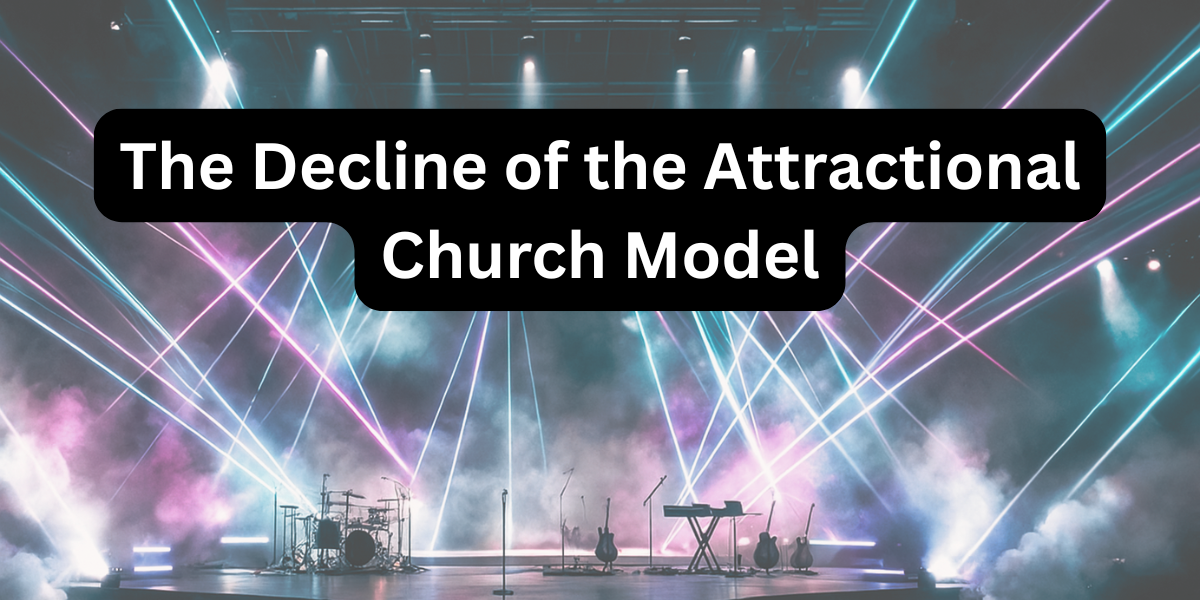
Somewhere along the way, the attractional church model turned Sunday worship into a show. Churches built stages that looked like concert venues. Creative teams programmed services like events. Pastors obsessed over “engaging experiences,” tight transitions, and the perfect emotional arc. It worked for a while. People came. Crowds grew. Metrics looked great. But when the lights began to fade and the smoke from the fog machine faded, the cracks started to show.
People aren’t looking for a polished spiritual production anymore. They’re worn out with the “three songs and a TED Talk” approach. They’re not against excellence; they’re just hungry for something real. Something weighty. Something rooted in historic Christianity.
And honestly? This shift is healthy. The attractional church model had its moment. But that moment is over for a lot of people.
The attractional model grew during the late 20th century. Churches noticed cultural distance growing between Christians and their neighbors. The solution seemed simple: remove as many barriers as possible. Make church appealing. Make it accessible.
So churches built buildings that felt like theaters. They created services designed for guests. Sermons leaned motivational rather than theological. Everything pointed toward one goal: get people in the room.
And to be fair, many people heard the gospel in those rooms. Lives were changed. The problem isn’t that this model existed. The problem is that we kept assuming it was the model.
The cultural moment that made the attractional model effective is gone. Everything has changed: people, expectations, trust, culture, technology, and the way the world sees Christianity.
People are starving for depth and meaning. Culture is thin. Digital life is noisy. Everyone is exhausted by constant marketing. Spiritual consumers aren’t looking for a clever experience anymore. They’re craving something more. They want Scripture that actually shapes their soul, theology that anchors their life, and worship that reveals to them who God is.
Shallow Christianity simply can’t sustain people in a chaotic world. Churches that offered motivational talks for spiritual encouragement are discovering those messages can’t hold the weight of people’s suffering, anxiety, and questions.
The future church is going deeper, not wider.
Churches can’t compete with Netflix, TikTok, or YouTube. The entertainment industry won that war a long time ago.
The attractional church model assumed churches needed to be entertaining enough to draw people in. But the digital world changed the rules. Someone can watch a world-class speaker or musician from their couch.
The wow-factor is gone. People aren’t showing up for a better show—they can get that anywhere. What they’re longing for is presence. They’re craving real community. They want worship that draws them into the glory of God, not the glow of a stage. They’re hungry for substance—truth with weight, depth, and roots.
When everything in culture feels new, shallow, anger-driven, and constantly shifting, people look for something old, thick, tested, and rooted.
They want the ancient faith.
They want creeds, confessions, and Scripture.
They want expository preaching that takes the Bible seriously.
They want prayers, liturgy, and sacraments that feel connected to centuries of saints.
This is why you see a resurgence in confessional Protestantism, Reformed theology, and liturgical patterns even in contemporary churches. The younger generations aren’t looking for nostalgia. They’re looking for anchors.
The attractional church model offered novelty.
Historic Christianity offers stability.
Church scandals, cultural conflict, and political polarization have eroded trust. People are skeptical of institutional polish. The attractional church model was built around projecting confidence and seamless execution. But today, perfection feels suspicious.
Real feels safe.
Authentic feels trustworthy.
A pastor who opens the Scriptures with humility builds more trust than a charismatic speaker with a perfectly rehearsed message.
The attractional church model unintentionally trained people to attend church rather than to belong to a church.
It created spectators instead of participants.
It created attenders instead of disciples.
It created consumers instead of worshipers.
It created fans of Jesus instead of followers.
And now that cultural Christianity has melted away, consumer Christians have drifted with it. The churches left standing are the ones building disciples, not drawing crowds.
For decades, attending church was socially beneficial. It made you look respectable. That world is gone.
Attending church doesn’t raise your reputation today. In some circles, it lowers it.
So people aren’t coming because they “should.” They’re only coming if the church offers something real.
The decline of the attractional model isn’t leaving a void. Something else is emerging in its place—something older, richer, and more faithful.
Let’s look at the new priorities rising across churches.
People want the Bible — taught clearly, faithfully, and in context. They want sermons that explain the text and show them the glory of Christ. They want to see biblical theology woven through every gathering.
Verse-by-verse exposition is making a comeback. Why? Because People want God’s Word, not the pastor’s opinions. An open Bible builds stronger churches and healthier Christians more than clever branding ever could.
What people want most is presence—the presence of God and the presence of God’s people.
They want pastors who are shepherds, not hosts.
They want worship that feels sacred, not scripted.
They want prayer that feels honest, not rehearsed.
The church is rediscovering something the early church never forgot: presence forms people more than production ever can.
No, I’m not talking about candles, icons, and Gregorian chants. What it means is that people want worship that’s connected to the church’s historic roots:
These things shape souls. Trendy programming doesn’t.
People know the difference.
They want pastors who tell the truth, not pastors who tell stories.
They want worship teams that lead with sincerity, not polished performers.
The future church is raw, honest, imperfect, and deeply committed to truth.
The attractional church model was built around attendance.
The future church is built around formation.
Churches are returning to:
This is not glamorous. But it is powerful.
Shifting from the attractional church model doesn’t mean throwing out excellence or ignoring creativity. It just means recentering the church around the things God actually commands.
Here’s how churches can pivot in a healthy way.
We must confess where we chased relevance over faithfulness. God cares more about holiness than hype.
Worship should be shaped by Scripture, not trends.
The 1689 Confession hits this clearly when it says:
“The acceptable way of worshipping the true God is appointed by Himself… not by any visible representation or any other way not prescribed in Scripture.”Scripture regulates worship.
Not culture.
Not creativity.
Not consumer expectations.
Read it.
Pray it.
Sing it.
Preach it.
Apply it.
The more Scripture you include, the healthier your people will be.
Hurry is the enemy of formation.
Slowness helps the soul breathe.
You can still have energy and passion without rushing through the sacred.
Attendance needs to stop being the win.
Transformation needs to become the win.
Discipleship — real, relational, biblical discipleship — has to become the engine of the church again.
Don’t assume they know how. Teach them why we pray. Teach them why we confess. Teach them why we sing. Teach them why we gather every week.
Churches become healthy when their people know what they’re doing and why.
Shepherds smell like sheep. Pastors are not CEO’s.
The more a pastor is among the people, the healthier the church becomes.
Platforms don’t change lives.
Pastors do.
| Attractional Model | Return to Historic Christianity |
|---|---|
|
|
The church isn’t moving backward. It’s moving back to something.
Back to Scripture.
Back to presence.
Back to depth.
Back to discipleship.
Back to the historic roots of Christianity.
This is not a fad. It’s a course correction.
God is purifying His church. He’s cutting away the fluff. He’s restoring what actually forms people into the likeness of Christ.
The attractional church model had a good run. It served a purpose. But its time is over.
And honestly?
Good riddance.
We don’t need better stage design.
We need better doctrine.
We don’t need emotional moments.
We need spiritual formation.
We don’t need theater-level production.
We need biblical worship, real community, and the presence of the living God.
God is raising up a generation hungry for truth, depth, community, sacrifice, holiness, and mission. These believers won’t be impressed by production. They won’t be satisfied with shallow spirituality. They’re craving the real thing.
This is not the end of the church.
It’s the end of the attractional church model.
And the beginning of something far better.
Delbra Hasley says:
You have reached the deepest depths of my soul. The time is short. I’m praying for you to be able to serve and communicate to others these truths and principles. May God’s favor be upon you and your family!
Jenny Lee says:
Eric, you hit the hammer on the nail. You expressed what I’ve been feeling for several years. So happy to see your writings. Tell Nicole I said hi
ericechols says:
Thank you, Jenny! I hope all is going well.