
Churches rarely become complicated on purpose. But creating a healthy discipleship rhythm can become surprisingly difficult as a church grows and its ministries develop.
Most of the time, complexity grows out of good intentions. A church adds a Bible study because people need to know Scripture. It starts groups because Christians need relationships. Men’s and women’s ministries develop because some conversations benefit from those settings. Then come children’s programs, leadership training, membership classes, and special events.
Each ministry may be useful on its own, but eventually, people reach the point where they need a working knowledge of the church calendar just to figure out how to participate. And once a discipleship strategy requires a flowchart and a minor in ecclesiastical logistics, something has gone sideways.
That was the problem we needed to address at Freedom Bible Church. We had meaningful discipleship opportunities, but the overall structure had become harder to understand than it needed to be. We needed a clearer discipleship rhythm, not another program.
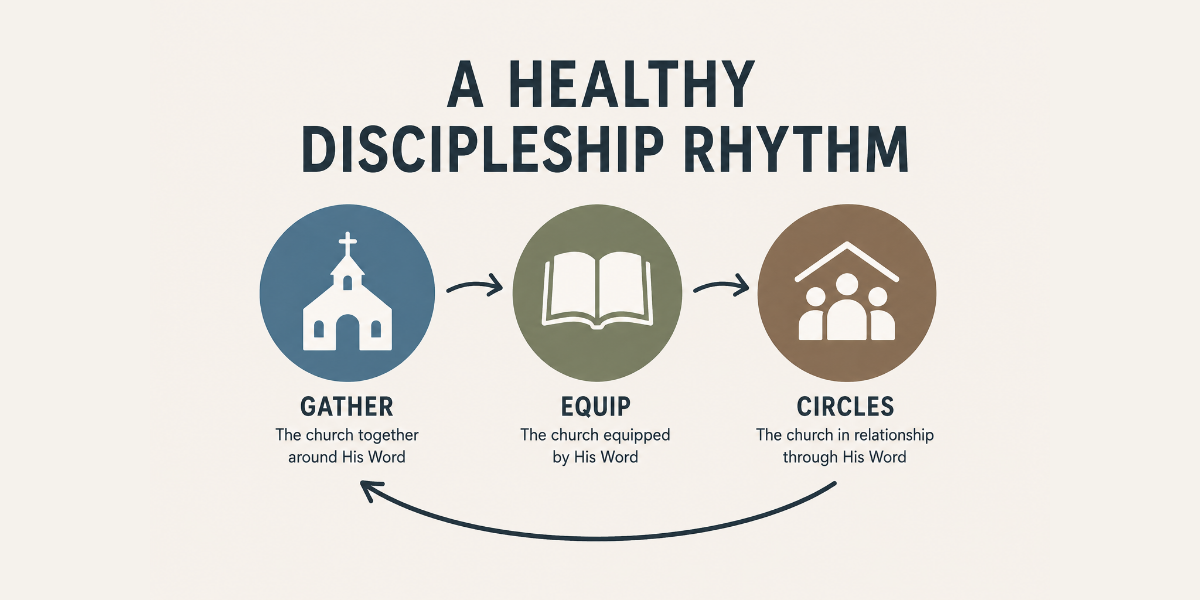
A healthy discipleship rhythm gives the church recurring opportunities to gather around the Word, be equipped for faithful Christian living and ministry, and develop relationships where believers help one another follow Christ. The specific structure will vary from church to church, but the biblical priorities should shape whatever structure we build.
Before we talked about calendars, we needed to ask a more basic question: What is discipleship?
Discipleship is the lifelong work of Christ forming His people into His likeness by His Spirit through His Word. He does not ordinarily form isolated Christians. Christ gathers believers into local churches where they worship, learn, pray, serve, encourage, correct, bear burdens, and help one another obey Him.
Our church’s confession gives helpful language for this. Chapter 26 of the 1689 London Baptist Confession describes church members as believers who give themselves “to the Lord and to one another.” Chapter 27 describes believers as united to Christ and therefore united to one another in love, sharing in one another’s gifts and graces, and serving one another for their mutual spiritual good.
That is far more substantial than attending a collection of religious activities. It is a shared life under the lordship of Christ.
Programs can support that life, but they cannot produce it. Church leaders do not manufacture spiritual transformation through clever programming. Christ forms His people through His Word and Spirit as they participate in the ordinary life He has appointed for His church. He gives pastors and teachers. He gives brothers and sisters. He gives prayer, fellowship, baptism, and the Lord’s Supper. He gives His people gifts to use for the good of one another.
Our responsibility is to steward those things faithfully.
That changed our organizational question. Instead of beginning with, “What programs should we offer?” we began asking, “What rhythms will help our people live out the responsibilities Christ has given His church?”
At Freedom, we describe those rhythms through three environments: Gather, Equip, and Circles. Those names are our language, not inspired terminology or a model every church should adopt. They simply help us explain how different aspects of the ordinary life of the church work together in making disciples.
Gather is our weekly Lord’s Day anchor.
Acts 2:42 describes the early church devoting themselves to the apostles’ teaching, fellowship, the breaking of bread, and prayer. Throughout the New Testament, Christians are not merely saved as individuals; they are gathered into churches that worship Christ and share life together under His Word.
When the church gathers, Christ forms His people through the preaching and hearing of His Word, prayer, singing, fellowship, baptism, and the Lord’s Supper. We hear the same truth together. We confess the same Lord. We pray for one another. We sing to one another. We come to the same Table. Week after week, we are reminded that we belong to Christ and to His people.
This means Gather cannot become one option among several coequal discipleship activities. The Lord’s Day gathering is the corporate center of our life together. Equip and Circles should flow from it, reinforce it, but never compete with it.
That distinction also protects us from treating discipleship as a specialized program for unusually motivated Christians. Every Christian needs the gathered church. There is no version of mature Christianity in which we graduate from needing Christ’s people assembled under Christ’s Word.
Ephesians 4:11–16 gives us the biblical purpose behind Equip.
The progression of the passage matters. Christ gives leaders to His church. Those leaders equip the saints for the work of ministry. As the saints minister, the body is built up. And as each part does its work, the church grows toward maturity in Christ.
That is a very different picture from pastors doing the ministry while everyone else watches.
Ministry belongs to the church. Leaders serve the church in part by preparing God’s people to use their gifts, speak the truth in love, serve one another, and participate in building up the body.
Equip creates intentional space for that work. It allows us to provide sustained biblical, theological, and practical instruction. Some subjects need more time for explanation, questions, discussion, and application than a Sunday sermon is intended to provide. Equip gives us room to work carefully through doctrine and the practical demands of Christian living and ministry.
But the purpose goes beyond transferring information. We want believers to understand Scripture well enough to live faithfully and help others do the same. Biblical knowledge should produce conviction. Conviction should shape obedience. And growing Christians should increasingly become Christians who can help others grow.
That is part of what it means for the saints to be equipped for the work of ministry.
Titus 2:1–8 gives us another dimension of the church’s discipleship life.
Paul begins with sound doctrine, but sound doctrine does not remain abstract. It produces a culture within the church. Older men are called to mature Christian character. Older women are to model holiness and teach what is good, helping younger women live faithfully. Younger men are urged toward self-control, and Titus himself is commanded to provide them with an example of good works.
The pattern is larger than a particular small-group structure. Titus 2 shows us mature Christians whose lives and instruction help form other Christians.
Our Circles are one way we intentionally make room for that kind of relational discipleship. We emphasize men discipling men and women discipling women because we want mature believers investing in others as biblical truth works its way into ordinary life.
Circles provide space for people to know one another well enough to apply Scripture beyond generalities. They pray together, encourage obedience, address struggles, ask honest questions, and help one another follow Christ through ordinary pressures and responsibilities.
This matters because discipleship always has to come home eventually.
Truth has to work its way into marriages and parenting, singleness and friendships, work and money, suffering and temptation, service and mission. A sermon can proclaim truth to the whole church. A class can explore that truth carefully. But Christians also need brothers and sisters who know them well enough to ask, “What does obedience look like for you right now?”
Simply putting people in the same room will not produce those relationships. Relational discipleship requires intentionality, trust, biblical conversation, and a willingness to be known. Circles cannot manufacture those things, but they give them a regular place to grow.
Gather gives us the corporate center. Equip gives us intentional formation. Circles give us relational application.
Once we were clear about the purposes of Gather, Equip, and Circles, we could address the calendar. The question was no longer, “What else should we offer?” It was, “How can these environments work together in a clear and sustainable discipleship rhythm?”
That led us to Discipleship Semesters.
Our semesters provide intentional seasons in which Equip and Circles work together while Gather continues as the weekly Lord’s Day anchor. The semester is not another ministry added to the calendar. It is the organizational rhythm that helps these complementary environments serve the same work of making disciples.
A typical semester begins with four focused weeks of Equip at the church. During those weeks, we establish a common biblical and theological foundation around a particular area of Christian life and ministry. We teach together, discuss what we are learning, and develop shared convictions and language that the church can carry forward.
Then we move into 10–12 weeks of purposeful Circles that meet primarily in homes. The emphasis shifts from focused instruction to relational discipleship. The teaching does not disappear; it gets worked into life. Men gather with men and women with women to pray, talk honestly, apply Scripture, encourage obedience, and help one another follow Christ in the ordinary circumstances of life.
That progression is intentional. Equip gives Circles something substantive to work with, and Circles keep Equip from becoming merely informational. Equip establishes a common foundation; Circles give that truth time and relationships in which to take root. One provides focused formation while the other provides relational application. Together they create a rhythm of truth taught and truth practiced.
Gather remains the corporate center throughout the entire semester. We are not moving people through three stages of discipleship as though they graduate from one to the next. Every Lord’s Day, the whole church continues to assemble around Christ and His Word. Equip and Circles extend that shared life into more focused environments for formation and relationship.
The semester structure also gives the church some needed predictability. Members know when focused teaching will happen and when Circles will begin. Leaders have time to prepare rather than constantly launching the next thing. Families can anticipate the rhythm and make wise commitments. And the church has natural seasons for preparation, rest, hospitality, and leadership development.
That matters because a healthy discipleship rhythm should be sustainable. Church members have jobs, children, aging parents, school schedules, neighbors, and responsibilities beyond the church building. Faithfulness to Christ is not measured by how many evenings someone spends at a church event. Our structure should encourage meaningful participation in the life of the church without creating a calendar that competes with the very responsibilities in which Christians are called to live out their faith.
For us, Discipleship Semesters provide that rhythm. Another congregation may organize these same biblical priorities differently, and that is perfectly fine. Scripture gives churches clear responsibilities, but it leaves considerable room for pastoral wisdom in how we organize ourselves to fulfill them.
The semester isn’t the point. The discipleship rhythm is.
We want the church gathered faithfully around Christ, equipped by His Word for the work of ministry, and living in intentional relationships where believers help one another follow Him. Discipleship Semesters simply give those priorities a clear, purposeful, and sustainable rhythm.
That distinction has become increasingly important to us.
Church structures are useful when they make faithful participation clearer rather than more complicated. People should be able to understand how the church intends to help them grow and where they can participate without needing years of insider knowledge.
That requires some consistency. People are already carrying real responsibilities at home and work. A recognizable rhythm allows families to plan, leaders to prepare, and the church to spend less time constantly explaining what happens next.
It also requires visible leadership.
Elders should do more than approve a discipleship strategy. They should teach within it, shepherd through it, and model the kind of relational investment they are asking the church to pursue. Not every elder will be able to participate in exactly the same way every week, but the discipleship ministry of the church should clearly matter to its shepherds.
If leaders tell the church that a ministry is central to its life while remaining largely absent from it, the calendar will eventually speak louder than the announcement.
A healthy rhythm can also help resist unnecessary fragmentation. Churches can unintentionally become collections of demographic ministries that happen to share a building. Men have their ministry, women have theirs, children have theirs, students have theirs, and somewhere along the way we can lose sight of the fact that Christ is building one church.
There are good reasons for age-specific and sex-specific discipleship in appropriate settings. Titus 2 itself gives us categories for intentional relationships between mature and younger believers. But those environments should serve the life of the whole church rather than becoming separate churches within it.
The same principle shapes how we think about families. The church should support and equip parents in discipling their children, not quietly replace them. A healthy discipleship rhythm should strengthen the relationship between church and home rather than forcing families to choose between them.
All of this points toward a fairly simple leadership principle:
The goal of church structure is not to keep people busy. It is to make faithful participation easier.
A full calendar can look impressive while exhausting leaders, dividing families, and leaving members unsure where they belong. Activity is a poor substitute for maturity.
Programs must remain servants. No one graduates from Christian discipleship. There is no advanced level where believers outgrow the gathered church, the Word, prayer, or their need for other Christians.
Our structures should keep directing people back to Christ and the ordinary life He has given His church.
So I would not recommend starting by copying Freedom Bible Church’s terminology or calendar.
Start with Scripture.
What has Christ called His church to do? How does He ordinarily form His people? What responsibilities do believers have toward one another? How should pastors and elders equip the saints? Where are mature believers intentionally helping others follow Christ? And what structures will help your particular congregation practice those things faithfully, clearly, and sustainably?
Some churches may discover they need fewer ministries. Others may need to connect good ministries that have been operating in isolation. Many may need to clarify the relationship between the Lord’s Day gathering, intentional instruction, and relational discipleship.
The answer will depend on the needs, leadership, and capacity of each local church.
The goal is not organizational uniformity. The goal is a healthy discipleship rhythm: a church gathered around Christ, equipped by His Word, and living in relationships where believers help one another faithfully follow Him.
No organizational structure can create that kind of life. Christ builds His church. He gives His Word and Spirit. He gives shepherds to equip His people and brothers and sisters to build one another up. He is the One who brings His body to maturity.
Our responsibility is less impressive, but still important: order the life of the church wisely so that our structures serve the work Christ has already given us rather than getting in its way.